Sublime Media - Case studies - Microsoft social learning frontier
5 lessons from the Microsoft social learning frontier

Best Unique or Innovative Learning Program
Microsoft Aspire Pi
How do you get someone to take ownership of their own learning and career growth? Ask the 2,000 early-in-career professionals who are voluntarily doing it at Microsoft through Aspire Pi.
There are no subject matter experts, trainers, or facilitators. Participants meet weekly to build connections, grow community, and foster profound personal growth—all through the power and potential of social learning.
At Sublime, we’ve been creating in-person and hybrid learning experiences for over twenty years. And we still had more to learn. Crafting this innovative program required us to re-examine our assumptions around social learning. Here are five lessons we uncovered.
Lesson 1: Like it or not, social learning happens everywhere
Learning from the advice and actions of those around us is baked into our DNA. In a workplace, social learning pops up everywhere, from tips shared around a water cooler to instructor-led training.
What if we embraced the wisdom employees bring to the water cooler? We've got a choice: Let social learning happen, uncontrolled and untapped. Or create an environment that fosters the best, most productive social learning.
This doesn’t mean surrendering your L&D program to the employee lounge. Social learning shows up in so many different forms, we must approach it thoughtfully to harness its potential.
Lesson 2: Examine the expertise
We invented a language to talk about different social learning experiences: the expertise continuum.

The expertise continuum maps the relationship between outside expertise and social learning forms. The more outside expertise you need, the more structured the social learning.
Imagine this: you want employees to learn about being more productive in their jobs. Where on the expertise continuum does this land?
In one version, all we need is to ask people to come together, each with a list of their favorite productivity tips, and share. That’s organic and conversational.
In another version, say you wanted to teach a very specific productivity method (e.g., the Pomodoro method). That only works if you bring in outside knowledge, so the form has to be more orchestrated with a teacher or facilitator involved.
Which one is better for you? That’s our next lesson.
Lesson 3: Go left. It’s worth it.
Think back to a meaningful in-person learning experience you’ve had. It could be a conference session, a breakout group, or maybe a passionate discussion. It’s likely you don’t remember every fact you learned. Rather, the experience and the people are what made it meaningful for you.
Social scientist David Dunning defines social learning as “insight through other people.” We’ve found that to be true: the more we connect with others, the more insight.
Not every social learning program should be purely organic. But every nudge left can improve the experience and enable conversations that grow people’s perspective—things they might not get in a classroom.
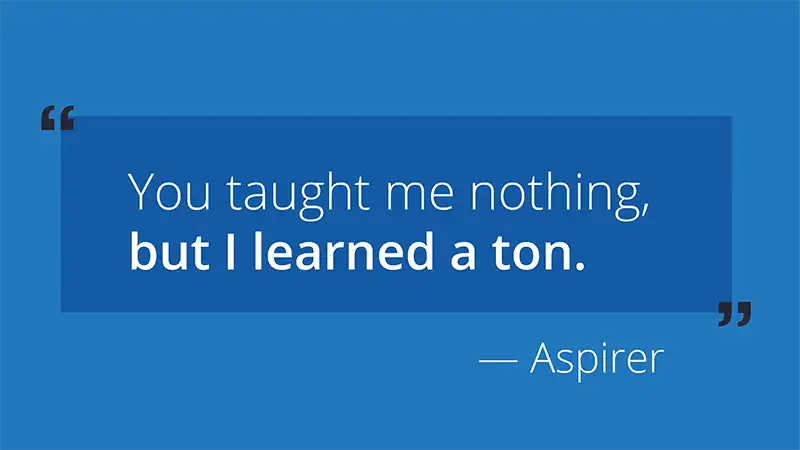
Lesson 4: Sometimes you have to let go of outcomes
Developing orchestrated social learning begins like most learning projects: with learning objectives. We design for desired outcomes instead of the experience. The more you move towards organic forms, the less you can rely on learning objectives. The more trust we put in learners, the less we can determine the specific outcomes.
What do you do instead? You can’t force organic social learning to happen, but you can create an environment in which it thrives. For Aspire Pi, we concentrated on how learning would happen rather than what learning would happen.
For example, it is essential everyone participates in Aspire Pi. To achieve this we drew on some unusual inspiration, a certain fantasy role-playing game: Dungeons and Dragons. If you aren’t familiar with D&D, each player has a role and they work together to slay orcs and find treasure—together, players tell a grand story of adventure. Sort of like a bunch of new Microsoft employees coming together to create the story of their careers.
Swapping healer for host and hidden treasure for professional development, Aspire Pi invites participants to take on a role, be it timekeeper, notetaker, feedback-gatherer, or jokester (bonus points for cat gifs).

We nurtured an environment in which every participant was comfortable and encouraged to take ownership and work together. In that trusting environment, we couldn't guarantee WHAT was discussed, but we could be certain the discussions were impactful and personal.
Lesson 5: Social learning doesn’t come in a box
If you’ve been to a convention in the past few years, you’ve heard the pitch: buy this platform and social learning will appear. The truth is not so simple. A powerful and effective social learning strategy should be customized to its environment and audience.
The two most important words in social learning are: FOR and BY. Effective social learning is tailor-made FOR your learners.
Insightful social learning is done BY your learners. They actively take ownership of the experience, even in small interactions, and gain insight along the way.